
Thand, Puwal Aur Chhath
Memories of a Secret Journey Halted at the Threshold
REFLECTIONS
Deepshikha Shukla
4/1/20264 min read
The winter in our village was unlike any other. It didn’t just visit; it settled in, quietly, like an old relative who knew every corner of the house.
गाँव के जाड़ (Gaon ke jaad) had its own temperament.
It came not only through the air but through sound and smell, the morning hand pump creaking, the soft moos of cattle rising in fog, the faint hiss from puwal catching fire in some far-off dalan (verandah) or courtyard. The sun took its time to appear, and when it did, it looked shy, diffused, like a coin held under muslin. What made those winters beautiful was not just the weather; it was the life inside them. Puwal, the golden straw left after paddy harvest, was everywhere, as if the land itself had grown a warm coat for the cold months. Our courtyard was lined with puwal stacks, taller than we were, golden towers that smelled faintly of grain and smoke. We’d climb them, slide down, and sometimes crash into each other, laughing. The friction burned our palms, but we’d do it again.
And, there were quilts, heavy and cotton-stuffed, smelling of sun from long afternoons of drying. The nights were thick with cousins, laughter muffled under quilts, someone’s leg pressed against yours. Mornings began with Dadi’s chai and lai (a crunchy sweet), Dadaji lighting a puwal fire that smoked our eyes but warmed our bones. Kartik month made everything a little more golden. The air itself seemed scented with gud (jaggery), ghee, and songs of Chhath (a festival). Every child waited for bursting patakhas (crackers) near the ghat, and every home smelled like preparation. It was these days, this rhythm, that we missed most when we came back to the city that year. It had been less than twenty-four hours since we had returned from Gopalganj after sixty long days of winter vacation. The train had brought us back to the city, but not completely. Part of us, our winter friends, our mornings, our warmth, had stayed back with Dada-Dadi. But we didn’t want this new version of the festival, the one with apartment balconies and artificial ghats.
So that night, as our parents discussed leaves and logistics, my brother and I decided to take things into our own hands. We went back, broke open our piggy banks (those tin boxes shaped like houses) and poured everything onto the bed. The coins clinked and rolled like a small treasure. When we counted, we had seven hundred and forty-two rupees, mostly from touching elders’ feet while leaving the village. It was an old village tradition; people, no matter how poor, pressed folded notes of eleven, twenty-one, or fifty-one into your palm, whispering, “Khush raho, mithai kha lena” (Stay blessed, eat sweets). Our largest donors were always Dada-Dadi and the newly married फुआ (paternal aunt). It wasn’t charity. It was a blessing in the form of currency.
My younger brother, whom I mostly considered a duffer, surprised me that night. He said, “We’ll follow the railway track… the Bagh Express goes straight to our village. Tracks always go straight.” It made perfect sense. The pending winter vacation homework also created a sense of urgency to execute the plan. We would wait at junctions for the train to pass, just to make sure we were going the right way.
We made a hand-drawn map on the back of my homework notebook, with crooked lines, arrows, and names of stations we could barely spell. That map was made after several failed discussions and errors, and once it was on paper, we were confident and proud of ourselves. My brother packed first: the doodle-like map, his bottle of kanchas (marbles) and two sweaters. He had become a local kancha (a marbles-based game) champion that winter. I packed lai, namkeen (salted snacks), and a notebook because it felt like something a responsible adult would carry. When Maa came in to check if we were studying, we quickly hid the map under the bedsheet and opened our books. My heart was thudding so loud that I was sure she could hear it. But she didn’t. She only said, “तू लोग जल्दी सुत जा” (You all should sleep early).
When she left, we looked at each other and grinned. We packed our bags properly this time. Everything was ready. Everything was real.
We whispered late into the night about everything we missed. We could already imagine ourselves eating jalebis (crispy sugary coils) at Chhath Ghat and playing Ludo with our cousins on a cosy puwal bed. We wanted to eat alsi bhaat (flaxseed and cooked rice) with pickle oil and chutney, my Dadi’s own fast food. We woke up before dawn, our hearts already halfway home. Everyone was asleep, so we tiptoed across the room, shoes in hand, bags on our shoulders, careful not to make the floor creak. I remember the way my brother whispered, “Are you ready?” as if we were going to war, not to our grandparents.
We came downstairs and pulled the gate. It didn’t move. There was a big fat lock hanging on it. My brother tried to shake the latch, then the handle, but the sound it made was hollow, like a small defeat. We didn’t speak. We just turned around and went back upstairs. The beds were still warm. We sat down and began doing our homework, not because we wanted to, but because there was nothing else to do.
We had no solution because our map started at the station, not at the gate.
About the Author
Deepshikha Shukla was born in Bihar and raised across the shifting landscapes of India. She holds a Master’s degree in Organisation Development from the Tata Institute of Social Sciences, Mumbai. Now based in the same city, her writing moves between memory and meaning, drawing from the textures of family, friendships, and inherited culture. It lingers in the spaces between belonging and becoming, tracing the subtle ways in which place, language, and love shape who we are.
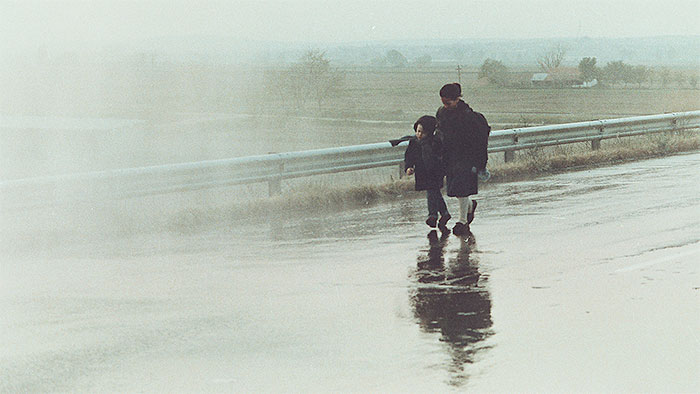
Cover Photograph: Screenshot from the movie Landscape in the Mist (1988), directed by Theo Angelopoulos.
Get in Touch
Contact
© 2026 Bihar Visual Archive & Lab. All rights reserved
Follow us
Send a Message
Join our Mailing List
| Privacy Policy |