
Loudspeakers, Sarees and Elections
Through the eyes of a young girl, a village election becomes a study of changing social tides and the quiet weight of a single vote.
REFLECTIONS
Deepshikha Shukla
4/1/20263 min read
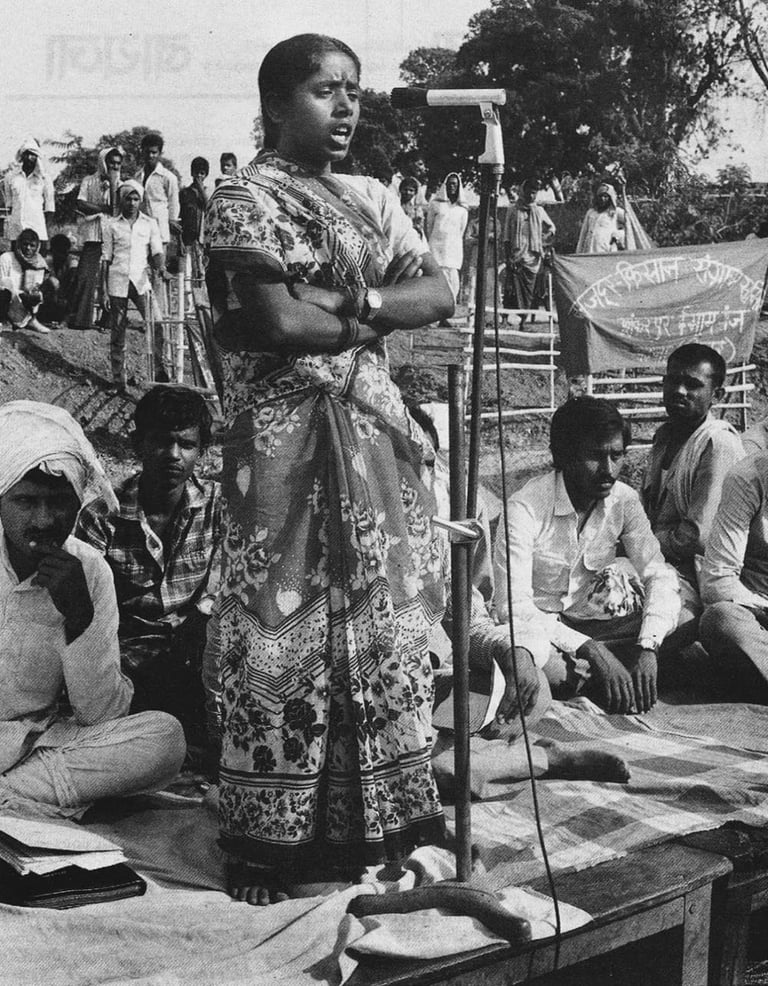
I still remember that summer, the one that seemed to last longer than all others, the one when politics entered our homes and lanes like dust carried by the wind. It was the year my friend’s mother stood for the Mukhiya (Chief) elections in a small village in Bihar. She was unlike most women I had known, always composed; she carried herself with a quiet authority that seemed to silence a courtyard when she entered. And yet, there was something ordinary about her too, someone you could see sitting on a charpoy shelling peas.
That year, however, she was transformed. Dressed in crisp sarees, sometimes wearing dark goggles, she stood tall on the back of an open tractor while campaign songs blared from loudspeakers. Her posters showed her face in bold, with a smaller photograph of her husband tucked into the corner, almost apologetically. The village itself had never looked so alive. From rooftops and windows, people leaned to watch the spectacle of women campaigning, as that year, the seat was reserved for women. For us, it was thrilling, volunteers with known and unknown faces moving through the heat, songs stitched with promises, the whirl of dust rising from tractors and running behind the cars to catch pink pamphlets.
I learnt new words that season. Someone called her Mukhiya Bo, and some preferred मुखियाइन (Mukhiyain) - both meant wife of Mukhiya. A phrase that felt odd because she was contesting for Mukhiya herself, but the world was not ready for rearranging itself. However, elections are not just a spectacle. They involve minor wounds and private betrayals. One afternoon, during house visits, my friend’s mother bent to touch my dadi’s feet. She accidentally put extra pressure on her toe ring, making it bleed. My dadi screamed out of pain, loud and clear. It was an awkward moment.
My uncle and grandfather were campaigning for different people, creating a divide in the family's political orientation. My dadu was an ardent supporter of one of his Muslim friends, who was contesting individually without any party support. In contrast, my uncle supported my friend’s mother from the neighbourhood. My grandparents voted for different people and never spoke of it to each other. That was their quiet pact. They walked to the polling booth together, stood in line like a pair, then vanished into their separate cubicles. What happened inside was never discussed again.
It was their own form of freedom, their own democracy.
When the results came, the air deflated. That lady had lost. She lost the election by a single vote. Was it my grandmother’s vote? I am still doubtful to this day. That incident lingers with me, as does how politics can turn on such delicate, invisible hinges. The campaign songs fell silent, the posters curled on the walls, and by evening, the tractors carried fodder instead of slogans. People went back to their routines, but something had shifted for me.
For many, she became a cautionary tale, “एक गो वोट से हारल” (lost by one vote). For me, she became something else. Not Kalpana Chawla, Kiran Bedi, or those distant names from books, but someone close, someone real. A woman from my village who had stood on a tractor in dark sunglasses got a mic to speak, faced the whole community, demanded a place in a world of men, adjusting with the title of Mukhiya Bo.
About the Author
Deepshikha Shukla was born in Bihar and raised across the shifting landscapes of India. She holds a Master’s degree in Organisation Development from the Tata Institute of Social Sciences, Mumbai. Now based in the same city, her writing moves between memory and meaning, drawing from the textures of family, friendships, and inherited culture. It lingers in the spaces between belonging and becoming, tracing the subtle ways in which place, language, and love shape who we are.
Photo credit: The History of Doing by Radha Kumar.
Get in Touch
Contact
© 2026 Bihar Visual Archive & Lab. All rights reserved
Follow us
Send a Message
Join our Mailing List
| Privacy Policy |