
Beyond the Ghat
Women’s Labour, Digitizing Devotion and the Evolving Nature of Chhath Puja
ESSAYS
Anushka Gupta
4/1/20266 min read
Introduction
Chhath Puja is not just a religious festival; it is also a cultural and emotionally related tradition that brings people and families together. It is one of the most sacred festivals of Bihar, now celebrated not only across India but also in many parts of the world. Every year, as the sun sets and rises over water bodies, countless devotees offer arghya (a sacred offering of water) to the Sun God and Chhathi Maiyya. But behind this faith lies a deeper story of gender, labour, and cultural continuity—one that shows how women have always been seen as the main carriers of culture and devotion. The atmosphere during that time was quieter, slower and more sacred. Even as I loved being part of it, I often found myself asking questions like - why do only women do all the work? Why are the men only on the sidelines and doing only outside work? Although everyone takes part in Chhath, why does the burden largely fall on women’s shoulders? Why is it that we can talk about only the joy and faith of this festival, but not about exhaustion or pain during this time?
Back then, I did not have the tools or words to understand these questions. But over time, especially after moving to Pune for my Master’s degree in Gender Studies, I began to understand how rituals, purity, and fear combine to shape women’s everyday roles. Chhath Puja, I realised, is not only a celebration of faith but also a reflection of how labour is divided and how cultural expectations are fixed within the home. I wanted to explore the festival I loved deeply, but this time, not only through emotion but also through a critical feminist lens.
Women, Culture, and the Discipline of Faith
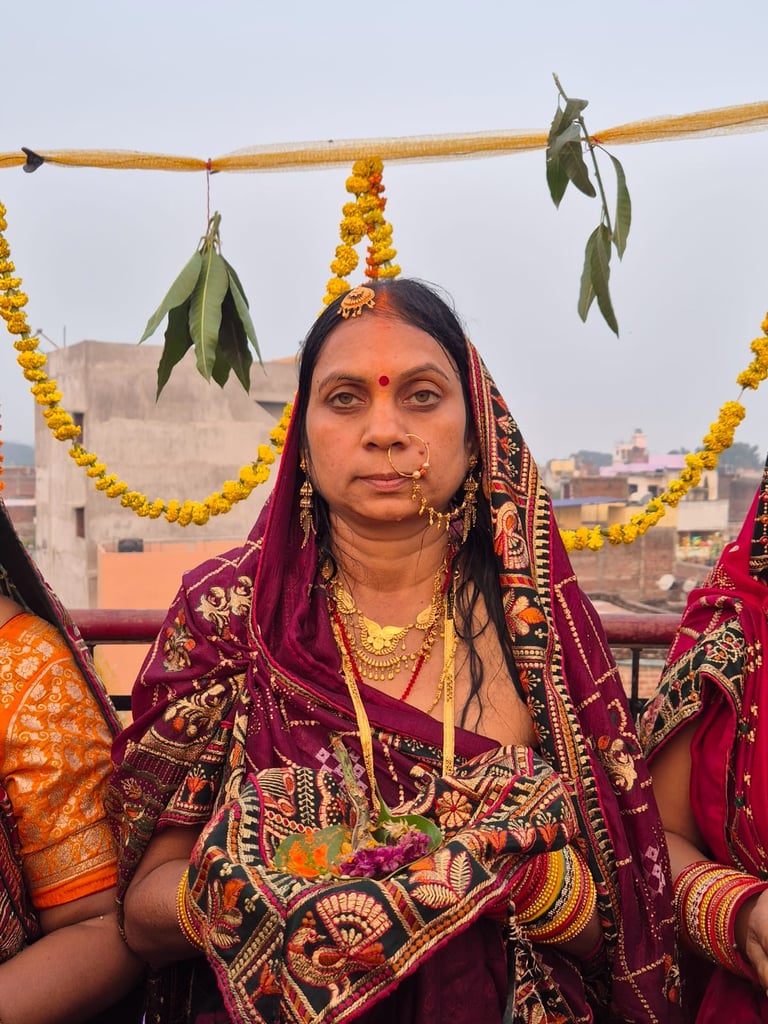
The name “Chhath” comes from the number six (chhath in Hindi), because it is celebrated on the sixth day after Diwali. The festival’s origins are linked to ancient sun worship, with references in texts such as the Ramayana and the Mahabharata. But for most of the women I spoke to during my fieldwork in Danapur, Patna, the meaning of Chhath does not come from the scriptures. It comes from mothers, grandmothers, and memories from the traditions passed down through generations. In Chhath, women take on the hardest tasks: fasting for 36 hours without food or water, cleaning every corner, washing utensils separately, and ensuring no impurity enters the ritual space. The vratin (usually a married woman) is expected to remain disciplined, calm and pure. This purity becomes a form of cultural value, showing how women’s bodies are linked to ideas of sacredness and morality.
Most women do not describe this as work. They call it sewa (service) or shraddha (faith). One woman told me, “We have seen our mothers and grandmothers do this. It is not work; it is our way of showing devotion.” Yet in this devotion lies both strength and exhaustion. The expectation of perfection, silence, and self-sacrifice travels from one generation of women to another, showing how culture often moves through women’s bodies, labour and emotions. Today, Chhath stands as a symbol of identity and belonging for people asserting their Bihari cultural roots.
Cover image: A Chhath vratin about to offer arghya. Image courtesy of the author.
Chhath Puja is not only a religious tradition but also a space where gender, class, caste, and social expectations are constantly being created and subverted. While Chhath is often described as a festival of family participation, my observations showed that women, both vratins (fasting women) and non-vratins, carry most of the physical and emotional burden. These acts are seen as natural parts of faith, but they reflect how gendered roles are reinforced within cultural spaces. Even when women say they love doing it, we must ask: what kind of support do they receive? What happens when there’s no one to help? These questions reveal how “shared tradition” often hides an unequal distribution of labour.
For most Biharis, especially outside their homeland, Chhath Puja is a way to hold on to identity. It is less about performing the ritual perfectly and more about remembering family, land and belonging. The festival becomes an emotional homecoming, even for those who cannot physically return. People may skip Diwali or birthdays, but they will travel miles to be home for Chhath. That emotional pull speaks to how this festival connects roots, relationships, and the feeling of being Bihari.
The Digital Assertion of Bihari Identity
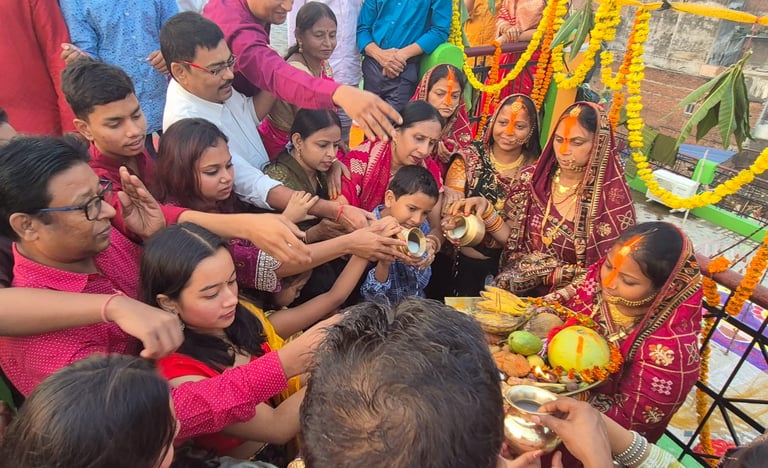
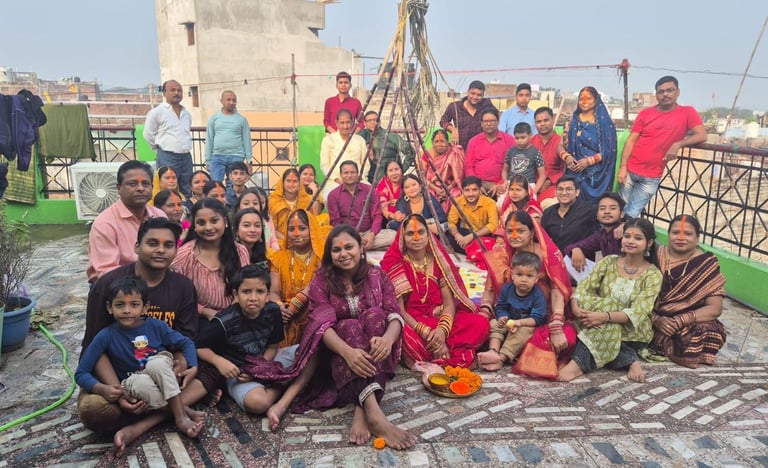
In today’s digital age, Instagram Reels and YouTube vlogs have turned Chhath into a visual spectacle. Social media has become not just a tool for documentation but a new space for performing and asserting cultural identity. I call this the “digital ghat,” a virtual extension of the riverside, where rituals are reimagined, emotions are shared, and belonging is displayed through screens. During my research, I noticed that even people living far from Bihar, whether in Delhi, Mumbai, or abroad, perform Chhath on rooftops or balconies. When they cannot reach the river, the rooftop becomes the new ghat, small yet sacred. This shift shows how rituals adapt to migration, how they travel and transform while retaining their emotional depth. Social media amplifies this further, connecting distant devotees through reels, photos, and live-streamed arghyas.
Devotees offering arghya during Chhath at the terrace of our house in Danapur in Patna. Image courtesy of the author.
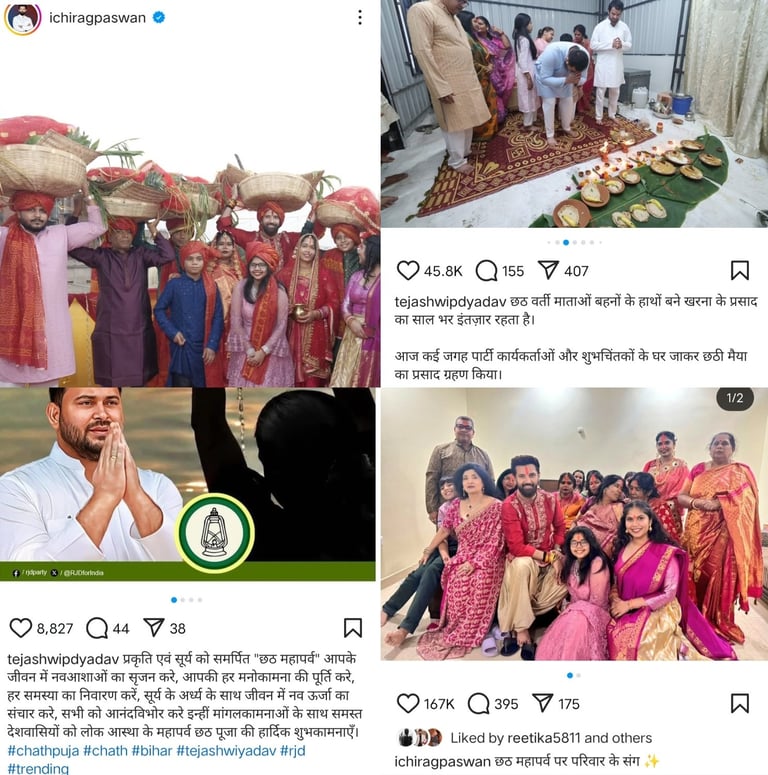
During the COVID-19 pandemic, when public gatherings were restricted, this digital transformation became particularly visible. Families celebrated together through video calls, and people posted photos of their home altars. The physical ghats were replaced by digital ones, yet the sense of community remained. This virtual participation blurred the lines between private and public spaces, redefining what it means to be part of a ritual community. However, this digitisation also brings class and performance into focus. The aesthetics of devotion, the perfectly decorated soop, daura, matching sarees, and scenic sunset images have become central to how Chhath is now represented online. The festival that was once about endurance and simplicity has entered the age of curated visuals. For many younger women, especially newly married ones, Chhath has become a medium to showcase faith and identity online. Performing the ritual is now equivalent to performing belonging. Social media has also allowed political leaders and influencers to participate in this digital devotion. Photographs showing them offering arghya or posting greetings on Chhath have become a part of cultural politics, turning the festival into a symbol of regional pride and religious unity. The digital ghat, then, is not only about emotion, but it is also about visibility, power and performance.
Social media turns Chhath into a digital space where rituals travel, adapt, and connect people across distances. Image courtesy of the author.
Faith, Labour and Cultural Continuity
Chhath Puja, in its evolving form, captures the deep intersection of gender, culture, and modernity. It shows how women’s unpaid labour sustains the sacred, how rituals shape identity, and how technology reshapes devotion. It also reminds us that women have always been central to the making of culture, not only as caretakers and devotees but as active agents who keep traditions alive through love and labour. Chhath continues to evolve from the ghats of Bihar to rooftops, from homes to Instagram, but its emotional and gendered core remains the same. The festival’s strength lies in this continuity, in the quiet hands of women who prepare, fast, sing, and pray, carrying faith across generations and geographies.
Yet, even as Chhath continues to gain visibility on ghats, rooftops, and screens, the unequal/double burden on women remains almost unquestioned. The festival celebrates their devotion but rarely acknowledges their exhaustion in the name of shraddha. The purity that is praised in public often demands silence in private. In celebrating culture, we must also ask: who sustains it, and at what cost? If Chhath is a symbol of identity and belonging, then it is time to recognise that women’s labour and bodies have long carried that identity without recognition. True devotion, perhaps, would mean freeing women from the expectation that faith must always come with sacrifice.
About the Author
Anushka Gupta finished her post-graduation in Women and Gender Studies from Savitribai Phule Pune University in 2025. She is now working as a Project Associate at Nirantar Trust in Bihar.
On social media, Chhath becomes a shared public expression of belonging, shaped by emotion, identity and politics. Image courtesy of the author.
Get in Touch
Contact
© 2026 Bihar Visual Archive & Lab. All rights reserved
Follow us
Send a Message
Join our Mailing List
| Privacy Policy |